
Reality check: no template guarantees profits, but it can remove the mistakes that kill consistency.
The one-screen trading plan
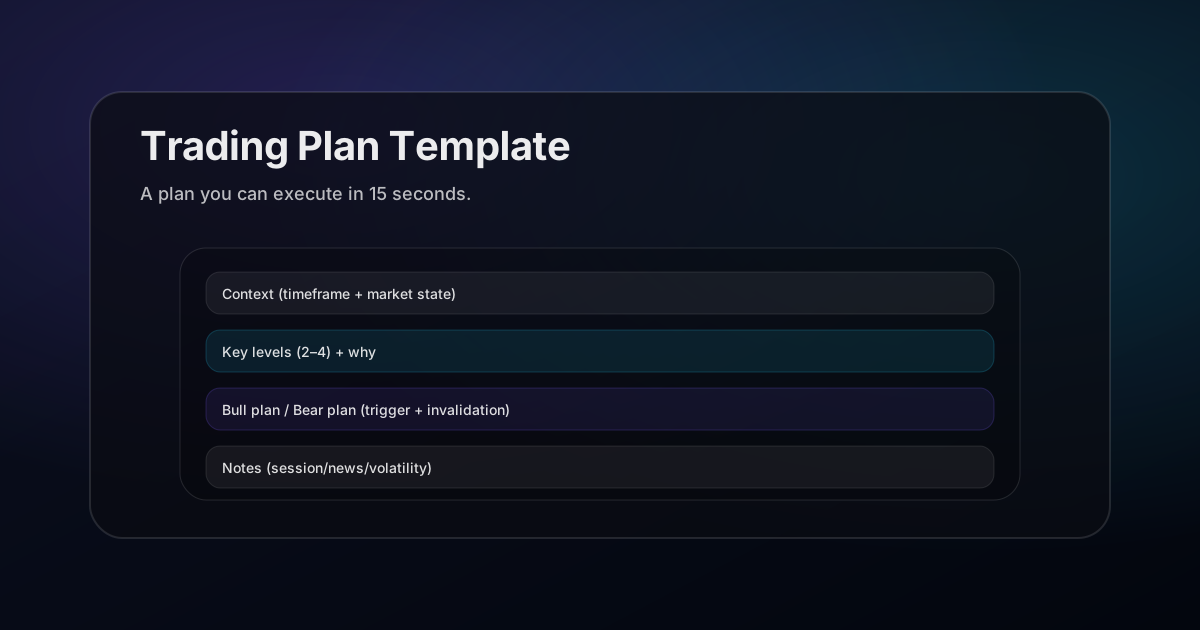
Copy/paste this into your notes and fill it in:
TIMEFRAME (execution):
CONTEXT (one sentence):

KEY LEVELS (2 to 4):
- Level 1: why it matters
- Level 2: why it matters

BULL SCENARIO:
- Trigger:
- Invalidation:
- Target zone:

BEAR SCENARIO:
- Trigger:
- Invalidation:
- Target zone:

RISK:
- Risk per trade:
- Position size:

NOTES (optional):
- Session/news/volatility:
How to keep it “clean”
- Limit levels: 2 to 4 max.
- Force two scenarios: no single-bias narratives.
- Trigger + invalidation: every scenario must have both.
- Risk first: size is decided before you enter.
Use AI to speed it up
AI is best at converting screenshots into structure. Tell it the format you want:
Turn this chart screenshot into a 1-screen trade plan.
Use the exact template blocks: Context, Key Levels, Bull, Bear, Risk, Notes.
Keep it short and give clear invalidation levels.
Why a plan written after the entry is worthless
A trading plan is not a document, it is a commitment made while you are still neutral. Once you are in a position, your judgement is compromised in specific and predictable ways. You will find reasons to move the stop. You will reinterpret a failing setup as a slower one. You will remember your thesis more confidently than you actually held it.
None of that is a character flaw, it is how everyone behaves under exposure. The plan exists to move the decisions to the one moment you can make them cleanly, which is before any money is at risk. If your plan is written after entry, it is not a plan, it is a justification.
Invalidation is the only section that must be exact
Every other line of the plan can be approximate. Invalidation cannot. It has to be a specific price with a specific condition, because it is the one field you will be tempted to renegotiate.
"I will exit if it looks weak" is not invalidation, it is a feeling with a price attached later. "I am out on an hourly close below 1.0820" is invalidation. It can be checked by someone else. It can be checked by you at three in the afternoon when you are annoyed and looking for a reason to stay in.
Write it as a level plus a trigger type. Level alone leaves you arguing about wicks. Trigger alone leaves you arguing about where. Together they close both arguments before they start.
Decide the exit plan before the entry plan
Most traders spend their preparation on entries and improvise their exits, which is backwards. Entries determine whether you are in the trade. Exits determine what the trade is worth. A mediocre entry with a disciplined exit outperforms a perfect entry managed on feel.
Fix three things in advance. Where you take partial profit, if you take any. What moves the stop and when, stated as a condition rather than a number of hours. And what makes you exit early despite the stop not being hit, which is usually structure failing in a way that was not part of the original thesis.
Be careful with moving stops to breakeven. It feels like risk management and often is not. Moving to breakeven the moment a trade is slightly green converts a lot of eventual winners into scratches, because normal retracement now closes you. Tie the move to structure, such as a higher low forming above your entry, rather than to a profit threshold.
The plan for when you are wrong twice in a row
Every plan handles the good case. The section that actually protects your account is the one covering consecutive losses, because that is when discipline breaks and position sizes creep up.
Set a daily loss limit as a hard stop, typically two to three times your per-trade risk. When you hit it you are finished for the day, regardless of how good the next setup looks. This is not superstition. After two losses you are measurably more likely to force a trade, and the setup that looks obvious is often obvious because you need it to be.
Add a weekly limit as well, and a rule for what happens after it. Reducing size by half until you have three winning trades is a common and sensible reset. The point is to make the response automatic so you are not designing risk policy while frustrated.
Review the plan against the outcome, separately
A good trade can lose and a bad trade can win, and if you review only by profit and loss you will learn the wrong lesson roughly half the time. Score two things independently: did I follow the plan, and did the plan work.
- Followed, and won. Nothing to change, keep the pattern.
- Followed, and lost. This is a normal cost of business. Change nothing on a single sample.
- Broke the plan, and lost. The clearest lesson available, and the cheapest one if you take it.
- Broke the plan, and won. The most dangerous outcome, because the market just paid you for the exact behaviour that will eventually take a large loss.
Log the category, not just the result. After thirty trades the distribution tells you whether you have a strategy problem or an execution problem, and those need completely different fixes. Traders routinely rebuild a strategy that was fine when the real issue was that they only followed it two thirds of the time.
One plan per setup, not one plan for everything
A single generic plan collapses under the first setup that does not fit it. Breakouts, pullbacks, and reversals fail differently, so they need different invalidation logic, and a rule written for one will quietly mislead you in the others.
A breakout is invalidated by re-entry into the range, so the stop belongs back inside it and the trade dies quickly when it is wrong. A pullback is invalidated by the prior swing failing, which is a cleaner and usually tighter level. A reversal is invalidated by the extreme being exceeded, and it is the setup most likely to need a second attempt before it works.
Keep a short plan per setup type rather than one long document. Three focused plans you actually read beat one comprehensive plan you skim.
Write the market context, then check it later
Add two lines describing what you believe about the wider market at the time of entry. Which way the higher timeframe is pointing, and what would change that view. It takes fifteen seconds and it is the field that teaches you the most on review.
Over thirty trades you will find that your results are not evenly distributed across contexts. Most traders discover they have one context where they are genuinely good and one where they consistently lose, and they had no idea because the two were averaged together in the overall win rate. You cannot find that pattern unless you recorded the context at the time, and reconstructing it afterwards does not work because you already know the outcome.
Once the pattern is visible the fix is usually simple, and it is rarely a better strategy. It is trading the same strategy only in the context where it works, and sitting out the rest.
Keep the plan short enough to actually use
A plan that takes ten minutes to fill in will not survive a fast market, and a plan you skip is worth nothing. Aim for something you can complete in under a minute: instrument, direction, entry trigger, invalidation, first target, size, and two lines of context.
If a field is not changing your decisions, delete it. Most abandoned trading journals died from having too many columns, not too few. The discipline you are building is the habit of writing anything at all before you click, and that habit is fragile in the early weeks. Protect it by keeping the cost low.
Related posts
- Best AI Chart Analyzer (2026): What to Look For
- Risk Management & Position Sizing
- How to Analyze Trading Charts with AI
- How to Find Key Levels (Day Trading)
- Support & Resistance Trading
- Break and Retest Strategy
Get ChartsGPT
Turn your screenshot into key levels, scenarios, trigger, and invalidation in seconds.


About ChartsGPT
ChartsGPT is an AI chart analysis app designed to turn screenshots into structured levels and scenarios. For support, contact anthonyvvza@gmail.com.